All twelve placements, not one
Sun, Moon, Rising, Venus, Mars, Mercury, Jupiter, Saturn, Uranus, Neptune, Pluto and your houses each feed the portrait. Most apps stop at your sun sign.
Most people say they recognise the face
Twelve placements. One portrait. See who your chart has been pointing at all along.
24hr Delivery · Delivered by email
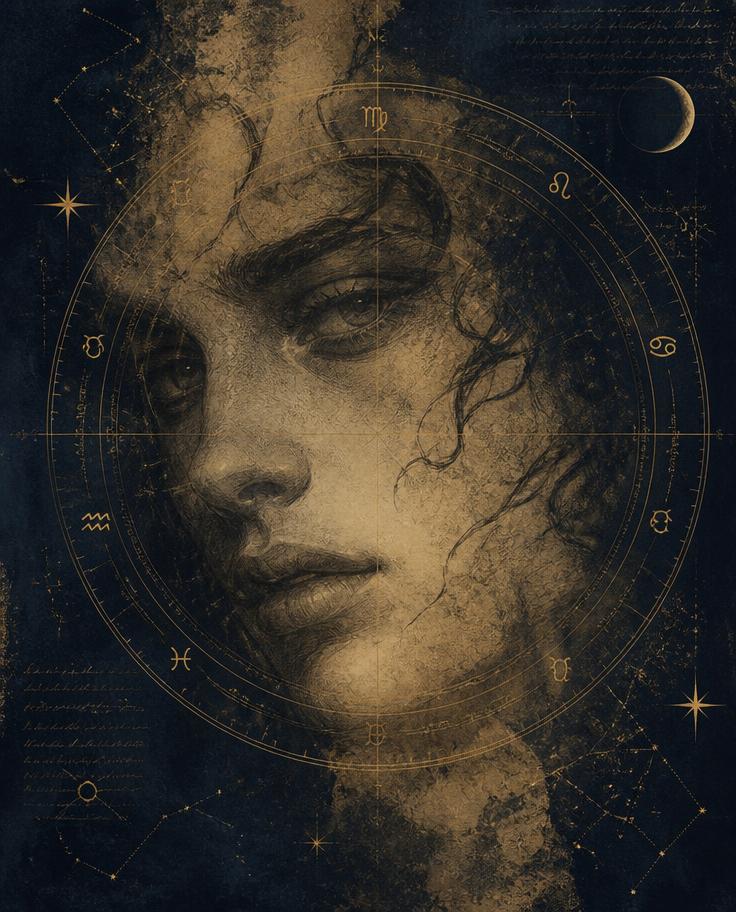
An Astro Lover Sketch is a drawn portrait built from your natal chart. You give a birth date, a birth time and a birth place. Those three details fix the exact position of every planet at the moment you arrived, and that arrangement is read as a description of the person you are most likely to fall for. Instead of returning a paragraph about your love life, the reading returns a face.
The logic is simple enough to explain in one line. Each placement in the chart is treated as a physical instruction. The Rising sign shapes the outline of the head and the way the person carries themselves. Venus sets the softness of the mouth and the shape of the eyes. Mars decides the weight of the jaw and the build. Saturn adds structure through the brow and cheekbones. The Moon supplies the expression the person wears when nobody is watching. Stack all twelve instructions and you no longer have a mood board. You have a specific face with specific proportions.
That is the part that separates this from the horoscope you scroll past every morning. Traditional astrology content divides the entire planet into twelve buckets and sends everyone in a bucket the same sentence. A full chart reading works from a combination that repeats roughly once every twenty-six thousand years. One data point out of twelve produces a fortune cookie. Twelve out of twelve produces a portrait.
The product is small on purpose. There is no dashboard to learn and no subscription ladder. Here is everything that actually ships with your reading.
Sun, Moon, Rising, Venus, Mars, Mercury, Jupiter, Saturn, Uranus, Neptune, Pluto and your houses each feed the portrait. Most apps stop at your sun sign.
Every position corresponds to one physical trait: jawline, eye shape, brow, hairline, build, even posture. The face is assembled, not imagined.
Aspects and angles change the reading. Two people born the same week can receive completely different portraits and completely different notes.
You also receive a written sketch: how this person handles conflict, affection, distance and commitment, so you know the temperament behind the features.
The quiz takes a few minutes. The finished portrait and notes land in your inbox, usually within a day, in a format you can save or print.
Your birth data is used to build one reading. Nothing is posted, published or shown publicly, and your sketch is yours to keep.
Birth date, birth time, birth city, and a handful of questions about what you notice first in people. Two to three minutes, no essay questions.
Your placements are calculated to the degree, then translated into the feature map: face shape, eyes, brow, nose, mouth, hair, build and bearing.
The features are assembled into a single charcoal-style portrait, finished so it looks like a drawing rather than a police composite.
The sketch arrives with the written profile, the placement notes behind each feature, and timing pointers for when this connection tends to surface.
Plenty of sites will sell you a soulmate drawing. Most of them ask for your sun sign, charge forty dollars, and email a generic sketch that could belong to anyone. The difference here comes down to three things: the depth of the chart read, the fact that the portrait is tied to named placements you can check yourself, and the price, which is zero to begin.
There is also a plainer reason people come back to this kind of reading. Researchers who study human connection keep landing on the same finding: the quality of our closest bonds tracks closely with long-term wellbeing. A portrait will not find anyone for you. What it does is give you a concrete, oddly specific description to hold up against the people already in your orbit, and that alone tends to make you look more carefully at the ones you have been walking past.
The most common reaction we hear is not disbelief. It is a pause, followed by some version of the same sentence: wait, I think I know this person. Sometimes it is a neighbour. Sometimes it is the friend who has been quietly circling for two years. Sometimes it is nobody yet, and the sketch becomes a bookmark instead of a mirror.
“I opened it at my desk and actually went quiet. The eyes and the crooked smile belong to a man I have been running into at my climbing gym for four months.”
“I expected a vague dreamy face. What I got had a specific nose, a heavy brow and notes about someone who withdraws before he explains himself. That part stung, honestly.”
“The written profile was the surprising part. It described a person who runs late and apologises too much, and I laughed because that is exactly my type.”
More reader reactions are collected on the testimonials page.
The reading starts at 0 USD. You complete the quiz and receive your portrait without entering payment details. Optional extras exist on the official site; none of them are required to get your sketch.
You can still order. An approximate time widens the margin on the Rising sign, which mainly affects the outline of the face. The rest of the mapping holds.
Most readings arrive within twenty-four hours. Check your spam folder if the first day passes quietly.
No. It is an interpretive drawing built from your chart. Treat it as a description with a face attached, not a lineup photo.
This site is an independent affiliate. For anything touching your order or your data, email the official support desk at support@astroloversketch.com. You can also reach this site through the contact page.
The full list lives on the FAQ page.
Two minutes of questions. Twelve placements read in full. One portrait, delivered to your inbox.
Free to start · Delivered by email · No card required
Readings are offered for entertainment and self-reflection. They are not a substitute for medical, legal, financial or psychological advice.